

The Lord says this:

‘The axe has no more power than the person who uses it.
A saw is not more important than the person who cuts with it.
A stick cannot lift up the man who holds it.
No, it is the man that lifts up the stick!’
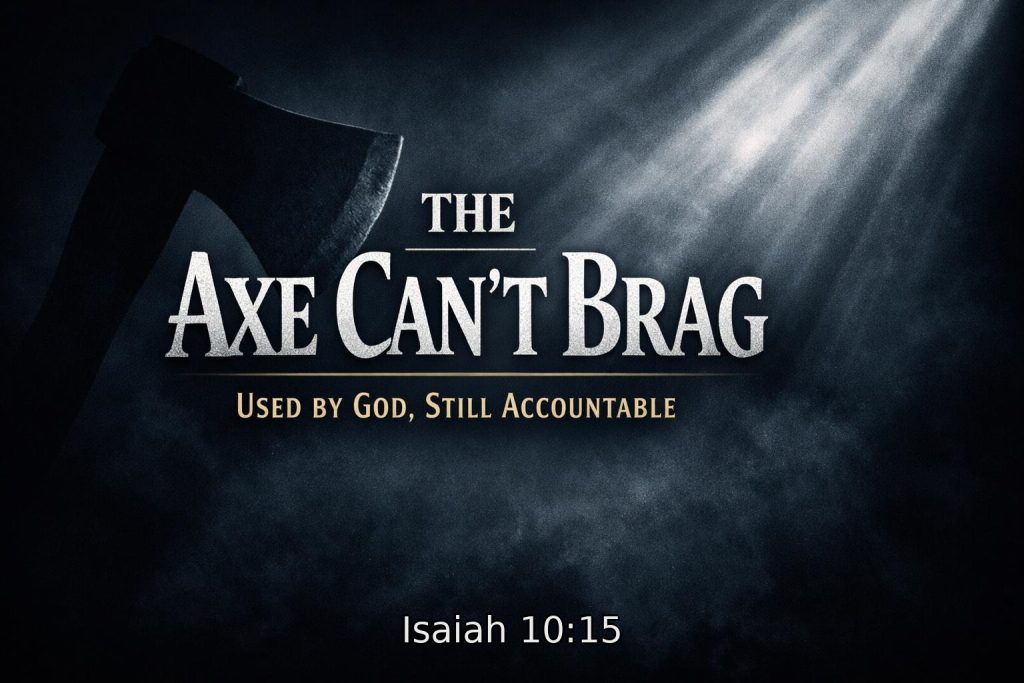
Isaiah 10 has one of the most sobering pictures in Scripture: God calls Assyria “the rod of My anger.” In other words, God was using a nation that didn’t even love Him to discipline His people and wake them up. But Assyria thought it was just normal life: power, ambition, conquest, “business as usual.” They took the credit. They enjoyed the damage. They bragged like they were unstoppable.
Then God asks a question that cuts straight through pride: “Does an axe raise itself above the one who swings it?” (see Isaiah 10:15). An axe is real, sharp, and effective. It can leave a mark. But it’s still a tool. It doesn’t choose the mission. It doesn’t get to boast that it created the strength behind the swing.
That’s the warning: God can use you, and you can still be wrong in your heart. God can work through someone’s actions without approving their motives. God can accomplish His purpose, and still hold people accountable for arrogance, cruelty, and self-worship. Being “used” by God is not the same as being aligned with God.
And this is where Judas gets painfully relevant.
Judas’ betrayal didn’t surprise Jesus. Scripture says it was part of what would happen (see passages like Psalm 41:9, and the way the Gospels describe it). But Judas was not a robot. Prophecy doesn’t erase responsibility. Foreknowledge isn’t the same as forcing someone’s hand. Judas still made choices: he loved money, he hid hypocrisy, he stayed close enough to Jesus to look spiritual, but far enough in his heart to sell Him.
Jesus’ words about Judas are terrifying: “It would have been better for that man if he had not been born.” (Matthew 26:24). And later Jesus calls him “the son of perdition” (John 17:12). Acts says Judas “went to his own place” (Acts 1:25). Christians have long understood those statements to point to judgment, not honor. The point isn’t to flex certainty about the details of Judas’ final destination like we’re the Judge, but to feel the weight: being near Jesus doesn’t automatically mean you belong to Jesus. You can play a part in the story and still miss the Savior of the story.
So here’s the teaching for us:
- Don’t confuse impact with approval. God can use you, but your heart still matters.
- Don’t steal credit. If God swung the axe, stay humble.
- Don’t weaponize God’s plan. “It was prophesied” is never a permission slip for sin.
- Ask the real question: Am I surrendered to God, or just involved with God?
Lord, don’t just use me. Change me.