

We live in an age of masks.
Social media has taught us how to curate our lives carefully. We adorn the outside, filter the image, adjust the lighting, and present a version of ourselves that looks whole. Everyone wants to be seen, admired, and followed. Everyone wants to look alive, even when something inside is quietly rotting.
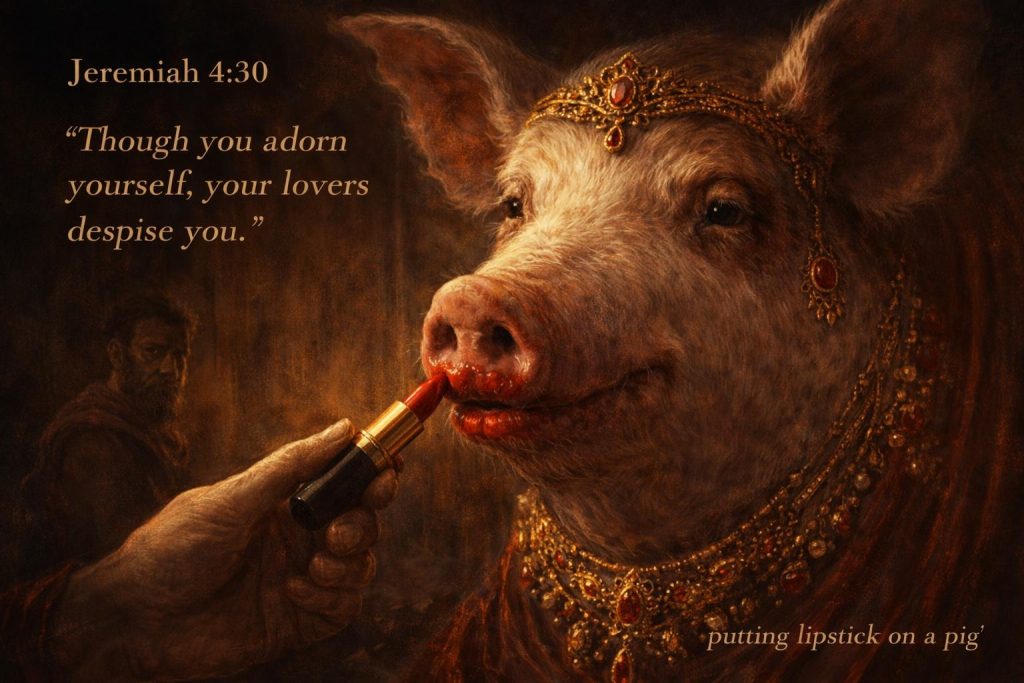
Fame has replaced faithfulness. Appearance took the place of honesty. We have learned how to decorate our unhealed wounds instead of healing them. We put lipstick on the pig and call it beautiful but no amount of makeup turns a pig into a lamb-cleaning the outside never heals the inside.
This instinct is not new.
Adam and Eve lived naked and unashamed. Their outward appearance did not matter because it reflected what was within. Good made them both in purity as they reflected the very Image of God (Imago Dei)1. They were the pinnacle of God’s creation because of the image which they bore. Their hearts were pure, so exposure carried no fear. They had nothing to hide. Together, they had intimacy with each other and also intimate with God, as they were living in the very presence of God.
But when they disobeyed God, tables were flipped; they turned everything upside down.
All of the sudden, their nakedness became unbearable. They covered their bodies because something inside them had fractured; they lost that purity of being seen for who and what they are. The shame was not in the skin; it was in the soul. Their covering was an attempt to manage exposure: that was the birth of the fear of being known.
Ever since, we have been doing the same thing.
We cover the outside to hide the disorder and chaos within. We pretend our lives are better than they are. We smile while breaking. We perform while decaying. We learn how to appear whole while our lives are hanging on the thread. Even people who could help us think that we are doing better than them.
The fear of being known is not the fear of exposure itself, but the fear of judgment that follows exposure.
We are afraid to give our hearts to God because we assume that being seen will lead to condemnation. Not only from God, but from people. Religion has often distorted this fear. While God looks at the heart, religion put a lipstick on a pig and call it beautiful. God seeks truth in the inner being; religion rewards outward performance and ritual.
So like Adam, we cover ourselves.
We hide behind fake humility.
We hide behind fake smiles.
We hide behind fake rituals.
We hide behind fake repentance.
Jeremiah saw this clearly in his generation.
The people crowded the temple, lifted their hands, sang their songs. But outside the walls, they returned to their folly like a dog to its vomit. They acted as if they had peace with God while serving other gods in private and sacrificing their children to Molech. When Jeremiah exposed the condition of their hearts, they hated him for it.
God spoke through him saying,
"And when you are spoiled, what will you do?
Even when you dress in red,
and wear objects of gold,
and enlarge your eyes with makeup,
you beautify yourself in vain.
Your lovers hate you, and seek your life."2
Here, God was saying, You look well on the outside. You run to your lovers who only desire your appearance. But I know your heart, and those you are trying to please will destroy you.
Exposure felt like betrayal. The people in Jeremiah’s time fled from the God who knew them inwardly, and that fear reduced them to appearance alone. Like a woman desperate to be desired, they invested everything in how they looked while neglecting who they were becoming.
The problem was not that God saw them.
The problem was that they were afraid to be known.
This fear appears again in the life of the Prophet Isaiah.
When Isaiah saw the Lord high and lifted up, when he heard the Seraphim cry “Holy, holy, holy,” he did not boast in his prophetic office. If there was a man who knew God in Judah, Isaiah would be the man; after all, he is the Prince of the Prophets. He did not compare himself to others or showed his accolades. He collapsed inwardly. “Woe is me,” he said. “I am undone.”3
Not just guilty. Undone. In the Hebrew word “Cut off” or “Destroyed”-or as an Old Testament Professor, John Oswalt put it, “Dissolved like better in the noon day sun”-exposed.
“I am a man of unclean lips.”
Why did Isaiah say lips and not heart? Because the mouth is the interpreter of the heart. Jesus put it plainly: “Out of the abundance of the heart, the mouth speaks.”4 What comes out of a person reveals what has been stored within them. The mouth does not create evil; it exposes it.
A man does not speak recklessly because he has been drinking. Alcohol only removes restraint. What surfaces was already there. The liquor did not put it in him; it simply gave it permission to come out.
Isaiah understood this. The same lips that had pronounced judgment on others now trembled in the presence of God. He had exposed the sins of the people, but now he himself stood uncovered before the One who sees beyond words and into the heart.
Before God, Isaiah was no longer the prophet with authority. He was simply a man, known completely, standing without defense.
The same thing happened to Peter.
After a long night of empty nets, Jesus told him to cast again. When the boats filled with fish, Peter did not celebrate opportunity. He did not negotiate advantage or tell Jesus, “Could please be my friend so that I can use you to further my fishing business?” He fell apart. “Get away from me,” he said. “I am a sinful man.”5
Peter had met teachers, leaders, scholars. But no one had ever known him like this. Jesus did not just perform power; he didn’t even have to utter a word. he exposed the heart by His actions. And exposure terrified him. He felt naked before Him.
This is our fear.
We want to be loved for what we reveal, while hiding the part of us that most needs love. We wear masks so well that even when people care for us, we feel untouched because that’s not the part that needs to be loved. We are praised by outsiders on the media, yet unsatisfied. Affirmed by people who barely know us, yet when we get to people who truly know us, we feel hollow. Loved, yet unknown.
My supervisor told me, “a child has a big ego because to a child, everything is ‘Mine Mine Mine’. Children thinks like the world revolve around them, then people are obliged to obey them. But when we grow old, the ego fades.” When I heard that, I agreed to disagree, not to further much psychological debate caricature. ego does not disappear with age; it simply learns how to hide better. We become skilled hypocrites. We manage appearances. We sweep pain under rugs. We develop angles. And slowly, quietly, learn to die on the inside.
Our deep fear of being known makes us depressed and anxious. Is it a suprising that in America, with the number of material and wealth around most people are not happy? Less than half of American are satisfy with their lives.6 Why? Most people live lives of “make believe”. Play the part to look the part while not being the part. We want people to love the part that we wrap around like a Christmas present and give to them, while ignoring the part that should be presented. We fear rejection because most people cannot love the unloveable part of us. Even when we find some people who would, we shun them and keep 10 feet away from them-Just like Peter said, “Get away from me; I am a sinful man.”
You can live with someone under the same roof and still not know them because they are afraid to show you the core of their hearts. Is it surprising that we may do the same to our kindreds? What about God? We cover ourselves despite God telling us that he would love us regardless; Yet we hide ourselves in the darkness because our deeds are evil. Jesus was hated not because he was meaner nor ugly nor judgmental, but He was a man of light and people loved their darkness. Those who knew how unloveable they were, came closer and closer to Him and sought his presence. Yet those who had their red dresses on, those put on gold and jewelry on, those who put on makeup to enlarge their eyes, feared Him because they were exposed to the real light. When can we stop pretending? Even the devil is called angel of light, not because he is, but he is a pig with a lipstick on! Jesus confronted the Pharisees and said, “You are of your father, the devil!” Why? Because they pretended to be light while having the fear of being known.
BEING KNOWN
What happens when we are finally known?
What happens when the masks fall and the coverings are removed?
What if being seen does not lead to destruction, but to healing?
Isaiah was exposed, but he was not destroyed. A coal touched his lips, not to burn him, but to cleanse him. Peter was exposed, but he was not rejected. Jesus called him closer, not farther away. Adam hid, but God still came walking in the garden asking, “Where are you?” Even after then, He killed a lamb and covered up his and his wife shame.
What if the fear was misplaced?
What if the One who sees us fully is the only One who can heal us truly?
We spend our lives covering what God wants to restore. We fear exposure, yet exposure is the doorway to grace. We hide our fractures, yet those fractures are where light enters. David knew this better after he sinned against God,
"Sacrifice you do not desire,
but a broken and contrite heart,
that you will not despise."7
In Christ is not where we perfect appearances. It is where we stop pretending. Where we stand uncovered before the God who already knows our nakedness. Where we discover that being fully known is not the end of us.
It is the beginning of healing.
- Genesis 1:26 ↩︎
- Jeremiah 4:30 ↩︎
- Isaiah 5:6 ↩︎
- Luke 6:45 ↩︎
- Luke 5:58 ↩︎
- https://news.gallup.com/poll/610133/less-half-americans-satisfied-own-lives.aspx ↩︎
- Psalm 51:16 ↩︎