
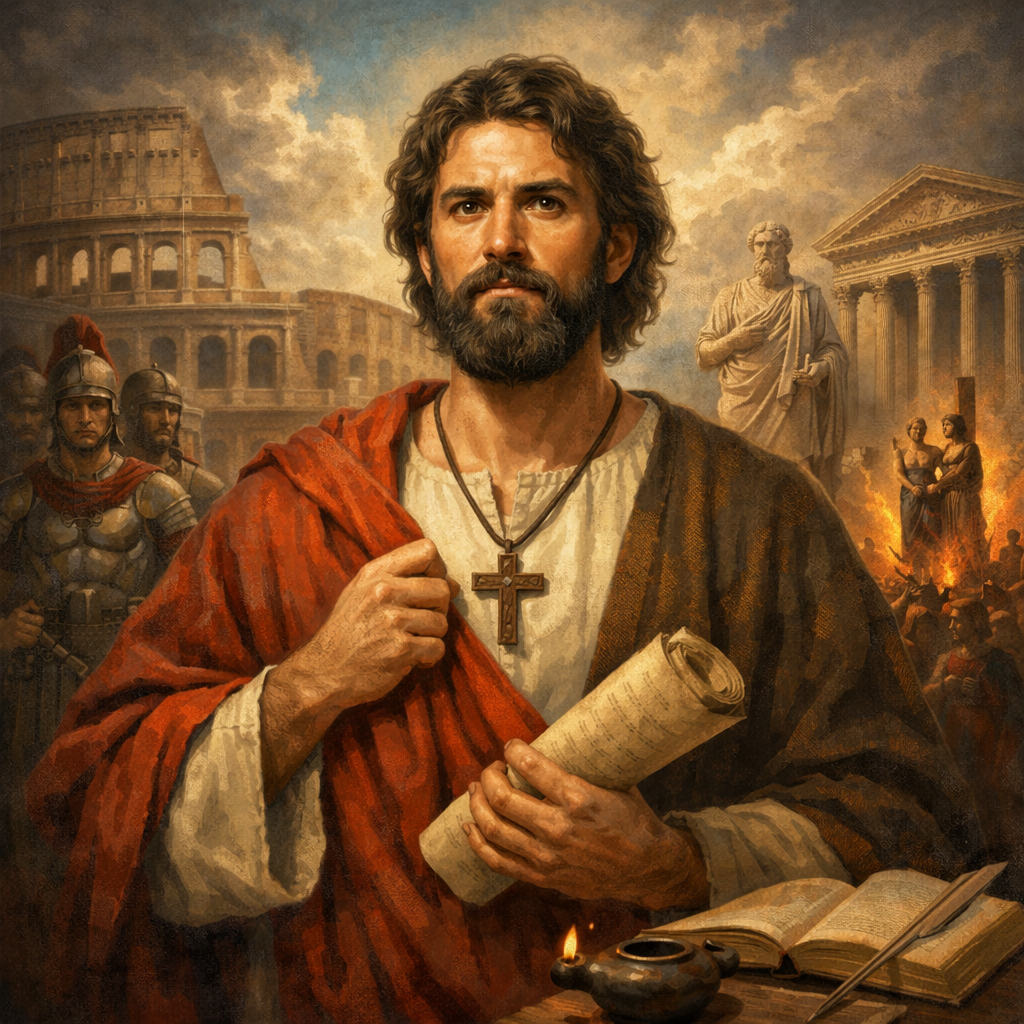
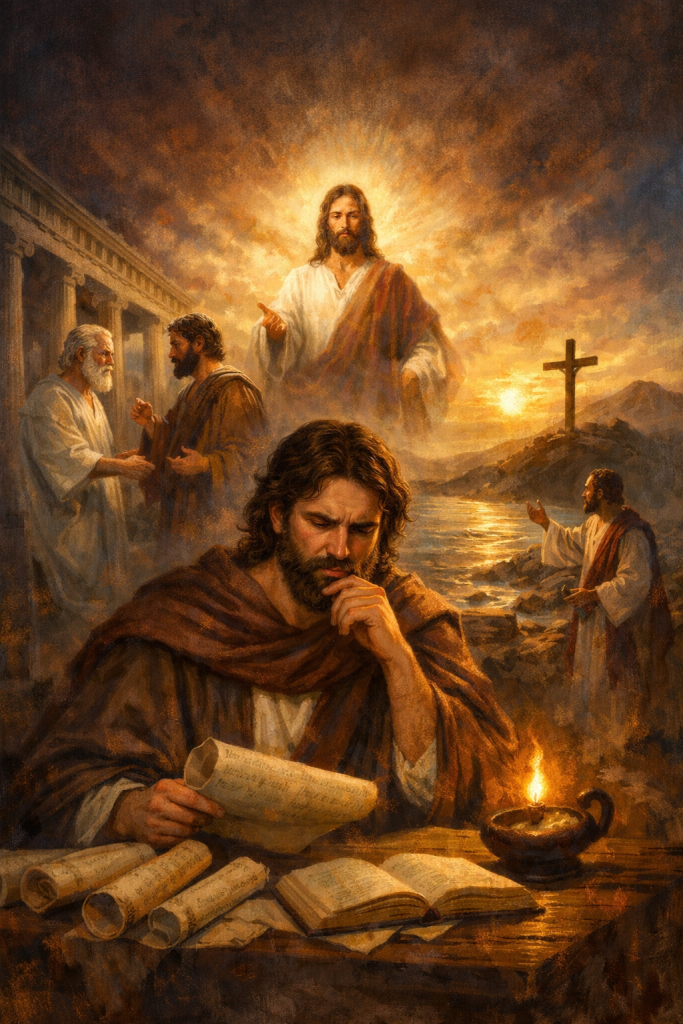
In the second century, Christianity was still a suspicious and often misunderstood movement in the Roman Empire, and believers could be mocked as foolish, immoral, or even dangerous. In that world came Justin Martyr, a recent convert with training in philosophy who refused to treat faith and reason as enemies. Instead of hiding Christianity from public debate, Justin stepped into the intellectual marketplace of his day and argued that Christians were not a threat to society, but people committed to truth and moral transformation.
Justin is one of the most significant figures in the early Christian movement because he helped Christianity survive and grow in a hostile culture in three key ways. First, he publicly defended Christians against Roman accusations by arguing that Christian worship and ethics were reasonable and socially beneficial, not secretive or criminal. Second, he built a bridge between Christian belief and Greco-Roman philosophy by presenting Christ as the divine Logos (the true “Reason” or “Word” that philosophers had been searching for, even without knowing it). Third, he strengthened Christian identity and unity by describing Christian worship and teaching in clear terms that corrected misunderstandings and showed outsiders what Christians actually believed and practiced.
Justin’s influence was immediate in his own time because his writings gave Christians language to answer persecution and public suspicion. His influence is still visible today in the way many Christians speak about faith as intellectually credible, morally serious, and deeply connected to the pursuit of truth.
Justin was born in Samaria, which was the Roman colony of Neapolis. Justin was a philosopher who studied Stoicism, Aristotelianism, Pythagoreanism, and Platonism. He later met someone who could answer him some questions that gnawed his mind, and only a Christian philosopher could answer. He came to Christianity because he thought it was another form of Philosophy that could answer his quest for truth1.
After that, in Rome, he started teaching Christian Doctrine in a private school, and he was later executed in 167 AD. Before his death, Justin fought for the defense of Christianity (Apology), and this battle was not only against one front but four fronts: against the so-called “Wise” pagans, the state that hated Christians, the Jews who opposed the deity of Christ, and also the Christian Heretics of his time. He wrote 2 Apologies; The first one, 1 Apology, he addressed the Emperor about the trials of Christian execution, and went against the practice of condemning Christians just because of their belief. The Second Apology was, 2 Apology, addressed to the Senate for another case of Martyrdom.
Justin not only challenged the status quo and the power that was, but also responded to charges of incest, cannibalism, atheism, and so on. Many people, especially in the time of the Greco-Roman world, assumed that Christians were cannibalistic because of the Eucharist (Eating the body and drinking the blood of Christ as directed in 1 Corinthians 11), which they did not understand how Christians do this only as a remembrance of Christ who died for us. People taught that Christians are completely immoral and undeserving to live in society.
Also, the Romans had many gods; therefore, they believed Christians were pagans or atheists because they only had one God in their Pantheon. People could choose many gods, especially the Romans, who worshipped many gods in their shrines, but they could not worship Jesus because that would disturb their Pax Deorum (Peace with the gods), having one god. Christians were considered to be like a plague since they did not bow to these other Roman gods. Justin the martyr comes to defend against this view, saying, “Christians are moral!” and he defends against the Jewish people who denied the deity of Christ. Justin goes to the scriptures (Old Testament, graphe), proving that Christ was prophesied in the same scripture that the Jews believed in. Christianity was not just assuming that Christ is God. Appealing to both sides reminds me of Paul’s letter to the Corinthians, chapter 9, verse 20-21, “To the Jews I became like a Jew, to win the Jews. To those under the law I became like one under the law (though I myself am not under the law), to win those under the law. To those not having the law, I became like one not having the law (though I am not free from God’s law but am under Christ’s law), to win those not having the law.”2 Justin appeals to this. He spoke to the State, the Jews, and the Pagans.
Justin stood between the State and the Synagogue; he was in the middle ground, trying to convert the whole Empire into Christianity. I also like what he did by using the pagans’ Greek mythology to appeal to pagans and explain Christ in the language that the Greeks would easily understand. One day, one Christian shunned me because I was reading Philosophy books, and I could not understand what all the fuss was about. As a person who was knowledgeable in Theology and Philosophy, I knew that Christ came in the period of the Greco-Roman world for a reason. People like John the Apostle used the language of Greek philosophers to explain the deity of Christ. Logos was not a new idea that John used; to appeal to the Greeks, he used the language the Greeks would understand. Yes, this was a Platonic view, and Plato was also searching for the grandeur and sublime3, and John explained how this “Logos” tabernacled among us. “Jesus is the very thought of God”, as Justin explained. If you want to know what God thinks, please know who Christ is because Christ is the very thought of God.
There was a Jewish activist, Abraham Joshua Heschel, who marched alongside Martin Luther King Jr. He also spoke about what is called “Divine Pathos,”4 which he explained was the way the Prophets were as the emotions of God. Justin also developed and explained Christ in the language of the pagans to appeal to them as the Divine Logos.
Justin also banished the secrecy about Christian Assembling together, by being involved in baptism and Sunday worship, and thoroughly explained the relationship between Christ and God, which at that time was a theological dilemma. Justin reminds me that our faith should not be secret; we should be able to articulate our faith in this very pagan culture, even if we are deserted and disowned, or it costs us our lives. After all, Jesus said: Count the Cost5.
Justin’s approach raises a question for Christians today: What does it look like to speak clearly about the faith in a skeptical culture? We want to be more inclusive and tolerant. Challenging the status quo today seems like a rebellious act. We barely raise apologists who are firmly against the heresies and the persecution of believers. I know some, like Rev. Ezekiel Dachom, who stood against Islamic extremists in Nigeria, which was heroic because he received some death threats6. I am fascinated with Justin’s courage, curiosity, and how he did not find most of the answers until he delved into the wells of Christian Doctrine. I see myself more in Justin, a man with an insatiable desire for truth and for answers, as Johnny Cash stated, “Anyone who wants the Truth ends up at Christ!”7 I did too.
- Everett Ferguson, Church History, Volume One: From Christ to the Pre-Reformation: The Rise and Growth of the Church in Its Cultural, Intellectual, and Political Context, 2nd ed. (Grand Rapids, MI: Zondervan, 2013) ↩︎
- 1 Cor. 9:20–21
↩︎ - Plato, Timaeus 29c–d (on the eikōs logos, a “likely/reasonable account”), trans. Donald J. Zeyl, in Plato: Complete Works, ed. John M. Cooper (Indianapolis: Hackett Publishing Company, 1997). ↩︎
- Abraham Joshua Heschel, The Prophets (New York: Harper & Row, 1962)
↩︎ - Luke 14:28
↩︎ - https://thewordfm.com/articles/contributors/milton-quintanilla/nigerian-pastor-receives-death-threats-after-exposing-christian-genocide
↩︎ - Johnny Cash’s quote
↩︎